Issue 94, 2025

Ligand exchange of tris(2,4-di-tert-butylphenyl) phosphite: a practical and efficient route to organo gold(i) complexes

Abstract

Tris(2,4-di-tert-butylphenyl)phosphite (2,6-tBu2-PhO)3P is used as a stable, easily displaceable ancillary ligand in the preparation of organo Au(I) complexes. The phosphite gold(I) precursors are bench-stable and readily accessible. They undergo high-yielding ligand exchange with a variety of ligands such as phosphines, N-heterocyclic carbenes and bidentate ligands. This ligand exchange strategy overcomes the limitations associated with traditional gold halide-based synthetic routes and is compatible with different organogold fragments. The protocol is scalable, operationally simple and broadly applicable.
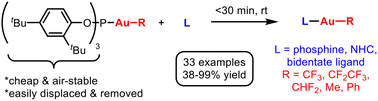
Graphical abstract: Ligand exchange of tris(2,4-di-tert-butylphenyl) phosphite: a practical and efficient route to organo gold(i) complexes

Supplementary files

Transparent peer review

To support increased transparency, we offer authors the option to publish the peer review history alongside their article.

View this article’s peer review history

Article information

Article type
Communication
Submitted
08 Oct 2025
Accepted
23 Oct 2025
First published
24 Oct 2025
This article is Open Access
Creative Commons BY-NC license

Chem. Commun., 2025,61, 18717-18720

Ligand exchange of tris(2,4-di-tert-butylphenyl) phosphite: a practical and efficient route to organo gold(I) complexes

D. Vesseur, S. Li, S. Mallet-Ladeira and D. Bourissou, Chem. Commun., 2025, 61, 18717 DOI: 10.1039/D5CC05744B

This article is licensed under a Creative Commons Attribution-NonCommercial 3.0 Unported Licence. You can use material from this article in other publications, without requesting further permission from the RSC, provided that the correct acknowledgement is given and it is not used for commercial purposes.

To request permission to reproduce material from this article in a commercial publication, please go to the Copyright Clearance Center request page.

If you are an author contributing to an RSC publication, you do not need to request permission provided correct acknowledgement is given.

If you are the author of this article, you do not need to request permission to reproduce figures and diagrams provided correct acknowledgement is given. If you want to reproduce the whole article in a third-party commercial publication (excluding your thesis/dissertation for which permission is not required) please go to the Copyright Clearance Center request page.

Read more about how to correctly acknowledge RSC content.

Social activity

Spotlight

Advertisements