


 PLATFORM UPDATE:

Recent advances in nanozyme–CRISPR/Cas biosensors

Abstract
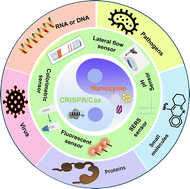
The clustered regularly interspaced short palindromic repeat (CRISPR)/CRISPR-associated protein (Cas) system, renowned for precise DNA recognition and potent trans-cleavage activity, has become a promising tool for biosensing. Nanozymes, a new class of artificial enzymes that combine the physicochemical properties of nanomaterials with the catalytic functions of natural enzymes, offer high surface area and versatile functionalization, enabling efficient target binding and catalysis to markedly boost biosensing performance. With advances across disciplines, the integration of nanozymes and CRISPR/Cas has become prominent in biosensing. Nanozyme-enhanced CRISPR/Cas biosensors can substantially improve detection sensitivity and expand sensing modes for bioanalysis, with potential for direct target detection without pre-amplification. In this review, we comprehensively examine recent strategies in nanozyme-enhanced CRISPR/Cas biosensing, with particular emphasis on advances in bioanalytical applications. We further critically assess the challenges and prospects of using nanozymes to improve CRISPR/Cas performance for biosensing and offer insights for the design of next-generation biosensors for precise, rapid, on-site detection of nucleic acids, proteins, and small molecules in clinical samples.
 Please wait while we load your content...


