


 PLATFORM UPDATE:

Exploring the limits of inductive electron withdrawal in fused bicyclic azaheterocycles
 a
Amruth
C.,
b
Eli
Zysman-Colman,
d
Gregory C.
Welch
b
and
Jeffrey F.
Van Humbeck
*b
a
Amruth
C.,
b
Eli
Zysman-Colman,
d
Gregory C.
Welch
b
and
Jeffrey F.
Van Humbeck
*b
Abstract
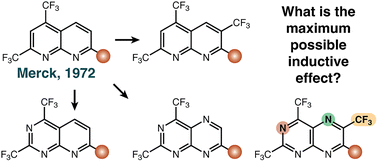
The ability to easily modify the electronic properties of aromatic azaheterocycles has led to their ubiquitous application across all disciplines of chemistry. The electronic properties of the aromatic π-system are most often modified by π-electron donating and withdrawing groups, naturally. Nearly fifty years ago, an important exception to this trend was reported, when the single-step synthesis of 5,7-bis(trifluoromethyl)-1,8-naphthyridine was described—a highly electron deficient system based exclusively on inductive electron withdrawing groups (CF3) and the inherent effect of nitrogen for carbon substitution. Herein, we report on efforts to extend these substitutions to create maximally electron withdrawn fused bicyclic azaheterocycles using only inductive effects. DFT calculations support the assignment of these structures as being strongly electron withdrawing, with ground-state LUMO energies as low as −2.91 eV obtained. Host-free OLEDs featuring these acceptor structures as part of polymer emissive layers show colors consistent with their electron-deficient character.
- This article is part of the themed collection: 2026 Pioneering Investigator Collection
 Please wait while we load your content...


