


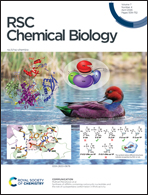
A new 4-atom linker enables PROTAC development and imaging
Abstract
Proteolysis Targeting Chimeras (PROTACs) are heterobifunctional molecules, emerging as a promising class of drugs.Amongst their structural components, the linker moiety plays a pivotal role in modulating their biological activity and physicochemical properties. Current PROTAC design strategies involve utilising shorter and more rigid linkers to limit the number of possible conformations within the ternary complex. We hypothesised that employing a short diyne spacer as the linker between the two ligands could generate highly potent PROTACs. Here, we report a series of diyne-bearing, low nanomolar BRD4 degraders recruiting the CRL4 CRBN E3 ligase complex. As well as providing highly-active degraders, the Raman-active diyne moiety also enables the label-free visualisation of intracellular drug uptake at low micromolar concentrations via stimulated Raman scattering (SRS) microscopy. This work demonstrates the potential of diyne-based PROTAC linkers for both drug development and to address a key challenge within the field in understanding the cellular uptake mechanisms and intracellular localisation of PROTACs.
 Please wait while we load your content...


