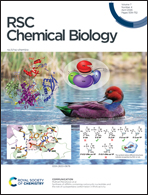
Native MS and Ligand Observed NMR Uncovers Subtle SLiM Binding Variations that Mediate HSP90-Hop PPI Modulation

Abstract

We have previously demonstrated that a non-natural tetrazole containing peptide (2), which mimics the MEEVD Short Linear Motif (SLiM) found at the Heat Shock Protein 90 (HSP90) C-terminus, disrupts the transient protein-protein interaction (PPI) formed between HSP90 and the HSP70-HSP90 organizing protein (Hop) co-chaperone. However, the native MEEVD SLiM (1) showed negligible inhibitory activity despite similar binding affinity to the interacting HopTPR2A domain. To investigate the origin of this discrepancy, we combined native mass spectrometry (nMS) coupled to ion mobility (IM) with saturation transfer difference (STD) and water ligand observed via gradient spectroscopy (WLOGSY) NMR to interrogate the interaction of peptides 1 and 2 alongside a series of peptide derivatives with HopTPR2A. Collectively, these data revealed that the variation in sequence between peptides 1 and 2 imparts subtle variations in conformational stability and magnetization transfer, indicating that differences in PPI modulation arise from altered binding mode rather than binding affinity. These results not only provide a structural framework for developing peptidomimetic HSP90–Hop PPI inhibitors, but a generalized strategy for exploiting transient PPIs for drug discovery.

Supplementary files

Article information

Article type
Paper
Submitted
21 Mar 2026
Accepted
05 May 2026
First published
06 May 2026
This article is Open Access
Creative Commons BY-NC license

RSC Chem. Biol., 2025, Accepted Manuscript

Native MS and Ligand Observed NMR Uncovers Subtle SLiM Binding Variations that Mediate HSP90-Hop PPI Modulation

T. K. Davids, D. A. Kusza, S. K. Misplon, J. Spath, R. Mhlanga, D. Clarke, B. G. de la Torre, F. Albericio, A. Edkins, M. Rylands and C. G. L. Veale, RSC Chem. Biol., 2025, Accepted Manuscript , DOI: 10.1039/D6CB00112B

This article is licensed under a Creative Commons Attribution-NonCommercial 3.0 Unported Licence. You can use material from this article in other publications, without requesting further permission from the RSC, provided that the correct acknowledgement is given and it is not used for commercial purposes.

To request permission to reproduce material from this article in a commercial publication, please go to the Copyright Clearance Center request page.

If you are an author contributing to an RSC publication, you do not need to request permission provided correct acknowledgement is given.

If you are the author of this article, you do not need to request permission to reproduce figures and diagrams provided correct acknowledgement is given. If you want to reproduce the whole article in a third-party commercial publication (excluding your thesis/dissertation for which permission is not required) please go to the Copyright Clearance Center request page.

Read more about how to correctly acknowledge RSC content.

Social activity

Spotlight

Advertisements