


DNA-programmed bispecific peptide assemblies for delivering cytotoxic payload to cells expressing EGFR and MET receptors

Abstract
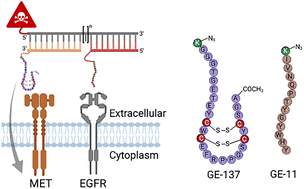
Bispecific agents capable of simultaneously targeting two distinct cell surface receptors promise enhanced specificity and efficacy in cancer therapy. Here, we report a strategy for the rapid optimization of compact bispecific agents using nucleic acid hybridization to display peptide ligands for both the epidermal growth factor receptor (EGFR) and the mesenchymal-epithelial transition factor (MET). The self-assembly process involved 20 and 21 nucleotide (nt) long DNA-peptide conjugates and 41–46 nt template strands, which precisely controlled the spatial arrangement of the EGFR-targeting peptide GE11 and the MET-binding bicyclic peptide GE137. We introduce improved synthetic methods for the challenging construction and functionalization of GE137, enabling its efficient conjugation to oligonucleotides. Systematic variation of peptide spacing revealed a striking distance-dependent affinity profile in interactions with live A549 cells, with optimal staining observed when GE11 and GE137 were separated by 21 paired and 3 unpaired DNA nucleotides. Incorporation of a cleavable cytotoxic payload (monomethyl auristatin E) into bispecific DNA–peptide constructs led to potent, HGF-dependent cytotoxicity, underscoring the requirement for targeted internalization. Conjugation to DNA effectively masked the cytotoxic payload, unless the combined activity of GE11 and GE137 induced internalization. This work establishes that DNA-directed assembly allows precise optimization of bispecific peptide agents that are much smaller than conventional constructs, offering robust targeting and conditional cytotoxicity. These findings highlight the promise of nucleic acid scaffolds for next-generation, cell-selective therapeutics.
 Please wait while we load your content...


