


 PLATFORM UPDATE:


Determination of vitamin B12 in blood samples using a SERS aptasensor based on dual-layer core–satellite plasmonic nanostructures
 *b
*b
Abstract
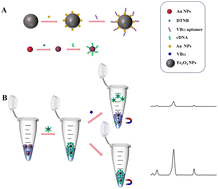
As an essential trace nutrient, vitamin B12 (VB12) plays a crucial role in maintaining normal metabolic processes and physiological functions in the human body, particularly in neurological development, overall growth, and energy metabolism in children. Therefore, the accurate and sensitive determination of VB12 levels in blood is of great significance for monitoring and evaluating children's growth and developmental status. In this study, a surface-enhanced Raman scattering (SERS) aptasensor was designed for ultrasensitive detection of VB12 in blood samples. The VB12 aptamer was modified on the surface of Fe3O4@Au nanoparticles (Fe3O4@Au NPs) to serve as the capture probe. Meanwhile, complementary DNA (cDNA) was immobilized on the surface of gold nanoparticles (Au NPs) functionalized with the Raman reporter molecule 5,5′-dithiobis (2-nitrobenzoic acid) (DTNB), serving as the signal probe. In this sensor, the VB12 aptamer hybridizes with the cDNA, forming a dual-layer core–satellite plasmonic nanostructure (Fe3O4@Au NPs-Apt/Au NPs-DTNB-cDNA). Quantitative detection was achieved by measuring the SERS signal intensity of DTNB at 1033 cm−1. Based on this design, the developed aptasensor exhibits high sensitivity toward VB12 with a detection limit as low as 0.73 pg mL−1. Furthermore, the SERS aptasensor demonstrates excellent specificity and stability when applied to the detection of VB12 in blood samples.
 Please wait while we load your content...


