


 PLATFORM UPDATE:


Preparation of fluorescent probes based on covalent organic frameworks (COFs) and their application in the detection of nitro-containing pesticide residues
 *a
*a
Abstract
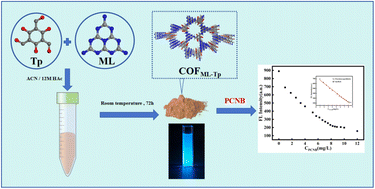
Pentachloronitrobenzene (PCNB), an organochlorine fungicide, poses a serious threat to the ecological environment and human health owing to its high toxicity and strong bioaccumulation potential. Therefore, establishing a simple and sensitive method for PCNB detection is of great significance for safeguarding public health and public safety. Covalent Organic Frameworks (COFs) possess advantages such as unique structure and excellent performance; when combined with high-sensitivity fluorescence detection technology, they show broad application prospects in pesticide residue detection. In this study, a novel fluorescent probe material (COFML–Tp) was synthesized at room temperature using melen (ML) and triformylphloroglucinol (Tp) as raw materials. Based on the Inner Filter Effect (IFE) occurring between PCNB and COFML–Tp, the fluorescence intensity of COFML–Tp is significantly reduced or even quenched, thereby realizing the quantitative detection of PCNB. Experimental results show that this fluorescent probe exhibits high sensitivity (limit of detection, LOD = 0.46 µM; limit of quantification, LOQ = 1.53 µM), a wide linear range (1.53–40 µM), and good selectivity in PCNB detection. Furthermore, the material has excellent chemical stability and hydrophilicity, providing a new approach for the detection of PCNB in aqueous environments. This study not only expands the application potential of COF materials in the field of pesticide detection but also provides technical references for pesticide residue monitoring and food safety supervision.
 Please wait while we load your content...


