


 PLATFORM UPDATE:


High-throughput spectral imaging combined with convolutional neural networks for simultaneous quantitative analysis of mixed anionic surfactants in aqueous environments

Abstract
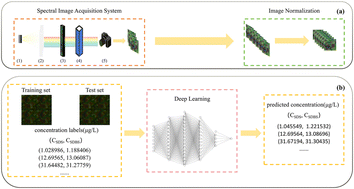
Anionic surfactants like sodium dodecyl sulfate (SDS) and sodium dodecylbenzene sulfonate (SDBS) are widely used but pose risks to aquatic ecosystems and human health when over-discharged, making accurate and efficient monitoring critical for environmental and public health protection. However, simultaneous quantitative analysis of these mixed pollutants remains challenging: existing detection methods (such as methylene blue spectrophotometry) rely on cumbersome pretreatment, follow a “single component–single wavelength” paradigm, and suffer from low throughput, long cycles, and poor adaptability to complex water matrices. To address this, we developed a pretreatment-free method integrating high-throughput spectral imaging with convolutional neural networks (CNNs). We constructed a multi-probe chromogenic system and generated 6216 concentration-dependent RGB images via wide-band spectral imaging. By replacing the Softmax layer in the pre-trained ResNet-50 network with a ReLU function and introducing a linear layer, we customized a regression model capable of non-linearly mapping spectral image information to surfactant concentrations. Experimental results show that random sampling significantly enhanced model generalization, with SDS/SDBS mean absolute errors (MAEs) reaching 0.80 mg L−1 and 0.80 mg L−1, with root mean square errors (RMSEs) reaching 1.612 mg L−1 and 1.655 mg L−1 respectively. The relative percent differences (RPDs) reached 5.432 and 5.281, respectively, while the coefficients of determination (R2) reached 0.96 and 0.96. The method demonstrated high sensitivity with a limit of detection (LOD) as low as 0.5 mg L−1. The model successfully adapted to different water matrices, showing excellent predictive performance and robustness in ultrapure water, natural water, and industrial wastewater. Notably, this established method eliminates the need for pretreatment steps such as liquid–liquid extraction, creating a new high-throughput paradigm for real-time mixed pollutant monitoring in complex environments and supporting aquatic monitoring upgrades and pollution control decisions.
 Please wait while we load your content...


