


 PLATFORM UPDATE:


Pulsecal: a valuable tool with limitations in deuterated organic solvents

Abstract
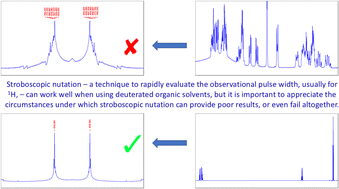
Stroboscopic nutation has proved to be invaluable for the rapid calibration of observation pulse widths, particularly for the 1H nucleus. Originally intended for aqueous solutions, especially for lossy samples and with a high protiated content of the solvent, application of the technique has been extended to all types of samples as well as other nuclei. Herein it is shown that pulsecal – the automated subroutine that performs stroboscopic nutation on Bruker instruments – can perform poorly for deuterated organic solvents and how this can be recognized. Conversely, it is shown under which circumstances pulsecal can perform well for deuterated organic solvents. But awareness of how pulsecal performs and knowing what a meaningful result should look like, how to extract meaningful values from a pulsecal spectral output, or how to direct pulsecal to use a suitable signal for measurement can all help avoid errant results. Thus it is important to evaluate the output of pulsecal to ensure it is correctly returning meaningful values. This need not be done on all samples but checks on a representative sample of a sample set or type of samples are recommended. Hence, when using pulsecal to measure pulse widths in deuterated organic solvents, due caution is advised and it is important to appreciate the limitations of pulsecal and when it is likely to underperform, or even fail altogether.
 Please wait while we load your content...


