


 PLATFORM UPDATE:


pH-gated bidirectional nanoassembly switches: self-ratiometric d-penicillamine sensing via AIE-active Au(i)-TCEP-Cd(ii) coordination dynamics

Abstract
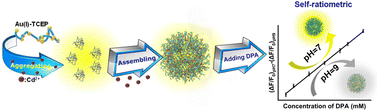
Self-assembly is regarded as a facile method to fabricate luminescent nanomaterials with aggregation induced emission (AIE) properties for optical sensor design. In this work, a pH-controlled self-ratiometric sensing platform utilizing aggregation-induced emission (AIE)-active Au(I)-TCEP-Cd(II) nanoaggregates was developed for highly reliable D-penicillamine (DPA) detection. Through stoichiometric coordination with Cd2+, oligomeric Au(I)-tris(2-carboxyethyl)phosphine (TCEP) complexes could self-assemble into snowflake-like nanoaggregates (∼100 nm) with strong yellow emission (540 nm) and excellent aqueous stability. The engineered nanoaggregates exhibited unique pH-dependent bidirectional fluorescence response: DPA induced emission enhancement at pH 7 through possible competitive coordination-mediated CdS quantum dot formation, while causing fluorescence quenching at pH 9 via nanostructure disassembly. This pH-switchable mechanism enabled self-ratiometric correction, significantly reducing interference from biological thiols (GSH and Cys) compared to single-mode detection. Systematic optimization revealed the optimal performance at 25 °C with 8-min equilibrium, achieving linear detection ranges of 0.5–6 mM (pH 7) and 0–12.5 mM (pH 9). The dual-mode cross-validation strategy improved the detection reliability, demonstrating 91.0–97.5% recovery in spiked serum samples through environmental reciprocation. XPS, TEM and time-resolved fluorescence measurements confirmed the reversible coordination chemistry underlying the pH-responsive behavior. This work established a novel paradigm for DPA monitoring through rational integration of metal-coordination chemistry and pH-tunable nanoassembly dynamics.
 Please wait while we load your content...


