


 PLATFORM UPDATE:


Determination of veliparib metabolic stability in the human liver microsomes using a hydrophilic interaction UPLC-MS/MS quantitative method: greenness assessment with an in silico study for ADME, DEREK alarms and metabolic lability

Abstract
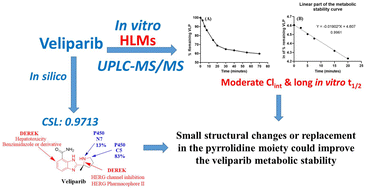
Veliparib (ABT-888) is a new and highly selective poly(ADP-ribose) polymerase (PARP) inhibitor that diminishes DNA repair efficacy following DNA damage, thereby enhancing the susceptibility of tumor cells to DNA-damaging drugs. A rapid and reliable UPLC-MS/MS method was developed for determining VLP concentration in the human liver microsomes (HLMs) and to assess the in vitro VLP metabolic stability. The validation of the UPLC-MS/MS approach was performed according to the US-FDA requirements for bioanalytical approach validation. The established UPLC-MS/MS method exhibited a good degree of greenness, as demonstrated by the ComplexMoGAPI score (71) and the AGREEprep tool score (0.68). The StarDrop software suite, comprising DEREK and WhichP450 tools, was utilized to detect in silico alarms regarding the VLP chemical structure and its metabolic lability. The present UPLC-MS/MS approach demonstrated linearity in the concentration span of 1 to 4000 ng mL−1, achieved ultra-rapid analysis in 1 min, and showed precision and repeatability free from HLM effects. Chromatographic differentiation of VLP and ceritinib (internal standard) was conducted utilizing a Luna 3 µm HILIC column (200 Å: 50 × 2 mm, Ea), with an isocratic mobile phase at 0.35 mL min−1 comprising 0.1% HCOOH acid in ACN (90%) and 10 mM NH4COOH in water (pH 3.2) at 10%. ACN, although having non-green aspects, is a necessary component for the desired chromatographic performance. The intra- and inter-day assessments of the accuracy and precision of the UPLC-MS/MS method varied from −4.67% to 5.74% and −7.33% to 8.07%, respectively. The metabolic stability parameters, including the in vitro half-life (t1/2) of 36.5 min and an intrinsic clearance (Clint) rate of 22.23 mL min−1 kg−1, indicate that VLP displayed a moderate degree of metabolic stability. These outcomes correspond to a bi-daily administration of VLP. Enhancing the metabolic stability can enable more convenient dosage regimens, improving the overall therapeutic experience for patients. In silico research indicates that minor structural alterations to the methoxy group or the pyrrolidine moiety (96% metabolically labile) in the drug design may improve the safety profile and the metabolic stability of novel derivatives relative to VLP.
 Please wait while we load your content...


