


 PLATFORM UPDATE:

Generative Adversarial Network-driven high-resolution Raman spectral generation for accurate molecular feature recognition
 a
Soumik
Siddhanta
*a
a
Soumik
Siddhanta
*a
Abstract
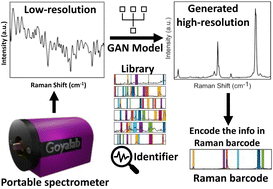
Through the probing of light–matter interactions, Raman spectroscopy provides invaluable insights into the composition, structure, and dynamics of materials. Obtaining such data from portable and cheap instruments is of immense practical relevance in several domains. Here, we propose the integration of a Generative Adversarial Network (GAN) to generate high-resolution Raman spectra with a portable hand-held spectrometer to facilitate concurrent spectral analysis and compound classification. Portable spectrometers generally have a lower resolution, and the Raman signal is usually buried under the background noise. The GAN-based model could not only generate high-resolution data but also reduce the spectral noise significantly. The generated data was further tested on a trained Artificial Neural Network (ANN) model for the classification of organic and pharmaceutical drug molecules, which was further used for spectral barcoding for the identification of unknown pharmaceutical drugs. This integrated system holds the potential for achieving accurate and real-time monitoring of noisy inputs to obtain high throughput output, thereby opening new avenues for applications in different domains. This synergy between spectroscopy and machine learning (ML) facilitates improved data processing, noise reduction, and feature extraction and paves the way for predictive modeling and automated decision-making using cost-effective portable devices.
 Please wait while we load your content...


