


 PLATFORM UPDATE:

Non-oxidative calcination enhances the methane dry reforming performance of Ni/CeO2−x catalysts under thermal and photo-thermal conditions†

Abstract
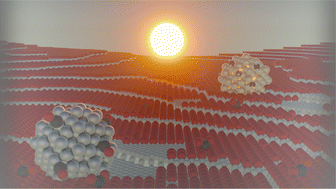
We analyzed the effect of the calcination atmosphere and visible-light contribution to an accelerated reaction rate and improved H2 selectivity over 2 wt% Ni/CeO2−x nanorod catalysts. Spectroscopic and structural characterization was performed by operando DRIFTS, in situ Raman, UV-vis and XAS techniques, which were complemented by DFT calculations. Calcination in an argon or H2 atmosphere yields 15% more active catalysts in the thermally driven reaction, which are also more susceptible to light-induced rate acceleration compared to the catalyst calcined in air. The most active 2Ni/CeO2 catalyst calcined in hydrogen converts methane with a rate of 7.5 mmol (gcat min)−1 and produces a H2/CO ratio of 0.6 at 460 °C when stimulated by a combination of visible light and thermal energy. In the absence of visible light illumination and at an identical catalyst temperature, the achieved methane rate was 4.2 mmol (gcat min)−1 and the H2/CO ratio was 0.49. The non-oxidative calcination improves nickel dispersion and the formation of subnanometer sized Ni clusters, together with a higher abundance of surface and bulk oxygen vacancies in ceria nanorods. The Ni–Ov–Ce3+components constitute the catalytically active sites under visible light illumination, which enable the DRM reaction to proceed with an Ea value of 20 kJ mol−1. Visible light also induces the following changes in the 2Ni/CeO2−x catalyst during the DRM reaction: (1) decomposition and desorption of carbonates from the nickel–ceria interface sites, (2) reduced population of nickel surface with carbonyl species and (3) promoted adsorption and dissociation of methane.
 Please wait while we load your content...


