


 PLATFORM UPDATE:

Tunable internal structure carbon sphere synthesis driven by water-solubility and its application in gas separation†

Abstract
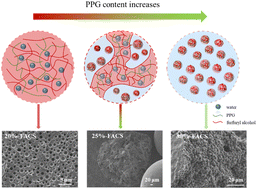
A method for synthesizing carbon spheres with a tunable particle size and internal structure from polyfurfuryl alcohol (PFA) was developed. By tuning the concentration of a structure directing agent (polypropylene glycol, PPG), we found a mechanism to tune the inner architecture of carbon spheres driven by water-solubility. A mixture of PFA and PPG transferred from the “water-in-oil” phase to an “oil-in-water” phase with an increasing content of PPG because of a difference in water-solubility between furfuryl alcohol (FA), PFA, and PPG. As a result, the internal morphology of the carbon sphere evolved from a “cheese-like” to a “pomegranate-like” structure, which was accompanied by an increasing specific surface area and pore volume. Furthermore, the separation of C2H2 and C2H3Cl was tested on the 25%-FACS (furfuryl alcohol-based carbon sphere) sample under different activation treatments with CO2 or CO2–NH3, with the coexisting “cheese-like” and “pomegranate-like” inner structures, owing to its moderate pore volume and mechanical strength. The maximum adsorption capacity of C2H3Cl reached 0.77 mmol g−1, while C2H2 was adsorbed in significantly lower quantities. It is believed that the high polarizability and high dipole moment of the C2H3Cl molecule primarily contribute to the excellent performance of C2H2 and C2H3Cl separation, and the introduction of polar N-containing groups on the carbon skeleton further promotes C2H3Cl adsorption.
 Please wait while we load your content...


