


 PLATFORM UPDATE:


Update on novel synthetic approaches towards the construction of carbazole nuclei: a review

Abstract
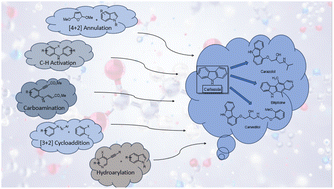
The carbazole scaffold is a significant entity in organic compounds due to its variety of biological and synthetic applications. Traditionally, carbazole skeletons have been synthesized either via the Grabe–Ullman method, Clemo–Perkin method or Tauber method. With the passage of time, these methods have been modified and explored to accomplish the synthesis of target compounds. These methods include hydroarylations, C–H activations, annulations and cyclization reactions mediated by a variety of catalysts to construct carbazole-based compounds. This brief review article intends to provide recent updates on important methodological developments reported for the synthesis of carbazole nuclei covering 2019–2023.
- This article is part of the themed collection: 2024 Reviews in RSC Advances
 Please wait while we load your content...


