


 PLATFORM UPDATE:


Stereoregular polymerization of phenylacetylene using alkynyl and methyl rhodium(i) complexes with functionalized phosphine ligands: linear vs. branched poly(phenylacetylene)s†

Abstract
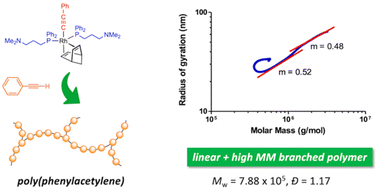
The alkynyl [Rh(C![[triple bond, length as m-dash]](https://www.rsc.org/images/entities/char_e002.gif) C-Ph)(nbd){Ph2P(CH2)3Z}2] and [Rh(CC-Ph)(cod){Ph2P(CH2)3Z}] (cod = 1,5-cyclooctadiene, nbd = 2,5-norbornadiene) and methyl complexes [Rh(CH3)(cod){Ph2P(CH2)3Z}] featuring functionalized phosphine ligands (Z = NMe2, OEt) have been prepared. These complexes efficiently catalyze the polymerization of phenylacetylene in the absence of a base to afford stereoregular poly(phenylacetylene)s with high molar masses. Polymer characterization by SEC-MALS and A4F-MALS revealed a bimodal molar mass distribution due to the presence of a high molar mass polymer fraction. The diene ligand in the alkynyl complexes influences the morphology of the polymers. The poly(phenylacetylene)s prepared with the square-planar alkynyl complexes [Rh(CC-Ph)(cod){Ph2P(CH2)3Z}] having cod as the diene are linear, whereas the catalysts [Rh(CC-Ph)(nbd){Ph2P(CH2)3Z}2] with nbd as the diene afford PPAs with a fraction of high molar mass branched polymer. However, neither the catalytic performance nor the PPA morphology is affected by the donor function of the functionalized phosphine ligand (–NMe2 or –OEt). The alkynyl complexes having nbd as the diene ligand, [Rh(CC-Ph)(nbd){Ph2P(CH2)3Z}2], are much more active than the square-planar alkynyl and methyl complexes having cod as the diene. These catalysts polymerize phenylacetylene at a faster rate than the catalyst [Rh(CC-Ph)(nbd)(PPh3)2] bearing a non-functionalized phosphine ligand and afford polymers with a much higher molecular weight.
C-Ph)(nbd){Ph2P(CH2)3Z}2] and [Rh(CC-Ph)(cod){Ph2P(CH2)3Z}] (cod = 1,5-cyclooctadiene, nbd = 2,5-norbornadiene) and methyl complexes [Rh(CH3)(cod){Ph2P(CH2)3Z}] featuring functionalized phosphine ligands (Z = NMe2, OEt) have been prepared. These complexes efficiently catalyze the polymerization of phenylacetylene in the absence of a base to afford stereoregular poly(phenylacetylene)s with high molar masses. Polymer characterization by SEC-MALS and A4F-MALS revealed a bimodal molar mass distribution due to the presence of a high molar mass polymer fraction. The diene ligand in the alkynyl complexes influences the morphology of the polymers. The poly(phenylacetylene)s prepared with the square-planar alkynyl complexes [Rh(CC-Ph)(cod){Ph2P(CH2)3Z}] having cod as the diene are linear, whereas the catalysts [Rh(CC-Ph)(nbd){Ph2P(CH2)3Z}2] with nbd as the diene afford PPAs with a fraction of high molar mass branched polymer. However, neither the catalytic performance nor the PPA morphology is affected by the donor function of the functionalized phosphine ligand (–NMe2 or –OEt). The alkynyl complexes having nbd as the diene ligand, [Rh(CC-Ph)(nbd){Ph2P(CH2)3Z}2], are much more active than the square-planar alkynyl and methyl complexes having cod as the diene. These catalysts polymerize phenylacetylene at a faster rate than the catalyst [Rh(CC-Ph)(nbd)(PPh3)2] bearing a non-functionalized phosphine ligand and afford polymers with a much higher molecular weight.
 Please wait while we load your content...


