


 PLATFORM UPDATE:


Synthesis, reactivity and coordination behaviour of a ferrocene phosphinostibine and intramolecular interactions in its P(v) and Sb(v) derivatives†

Abstract
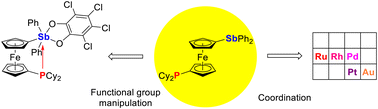
Compared to their P,N-analogues, compounds combining P and Sb substituents remain less common. This contribution describes the synthesis of a new ferrocene phosphinostibine, Cy2PfcSbPh2 (3; fc = ferrocene-1,1′-diyl, Cy = cyclohexyl), and its derivatives modified at the phosphine and stibine moieties, viz., Cy2P(E)fcSbPh2 (E = BH3, O, S, AuCl), Cy2P(E)fcSbCl2Ph2 (E = BH3, S, AuCl) and stiboranes Cy2P(E)fcSb(O2C6Cl4)Ph2 (E = void, BH3, O, S and AuCl). The increased Lewis acidity of the Sb atom in the catecholatostiboranes Cy2PfcSb(O2C6Cl4)Ph2 and Cy2P(O)fcSb(O2C6Cl4)Ph2 resulted in intramolecular P → Sb and O → Sb dative interactions, which were not detected for the respective parent stibines or even in Cy2P(S)fcSb(O2C6Cl4)Ph2. While the P → Sb interaction in Cy2PfcSb(O2C6Cl4)Ph2 was stronger than that in the “all-phenyl” analogue Ph2PfcSb(O2C6Cl4)Ph2 due to the electron-donating effect of the cyclohexyl groups, the bonding situations in Cy2P(O)fcSb(O2C6Cl4)Ph2 and Ph2P(O)fcSb(O2C6Cl4)Ph2, where the substituent effect was only indirect, remained very similar according to DFT calculations. A coordination study with 3 resulted in isolation of phosphine ([AuCl(3-κP)]), P,Sb-bridging ([(μ(P,Sb)-3)(AuCl)2]), and P,Sb-chelate ([(arene)MCl(3-κ2P,Sb)]X, where (arene)M/X = (η6-p-cymene)Ru(II)/PF6, (η5-C5Me5)Rh(III)/Cl, and (η5-C5Me5)Rh(III)/PF6, and [MCl2(3-κ2P,Sb)], where M = Pd and Pt) complexes. For some of these compounds, structure determination revealed structural distortions suggesting weak intramolecular Cl–Sb interactions, which were confirmed by theoretical methods.
 Please wait while we load your content...


