


 PLATFORM UPDATE:

Phenylstyrylpyrimidine derivatives as potential multipotent therapeutics for Alzheimer's disease†
 a
Vinod
Kumar
*a
a
Vinod
Kumar
*a
Abstract
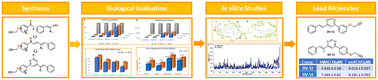
Alzheimer's disease (AD) is a multifactorial neurological disorder that affects millions of people worldwide. Despite extensive research efforts, there are currently no effective disease-modifying therapeutics available for the complete cure of AD. In the current study, we have designed and synthesized a series of phenyl–styryl–pyrimidine derivatives as potential multifunctional agents against different targets of AD. The compounds were evaluated for their ability to inhibit acetylcholinesterase (AChE), monoamine oxidase (MAO) and β amyloid aggregation which are associated with the initiation and progression of the disease. Several compounds in the series exhibited potent inhibitory activity against AChE and MAO-B, with IC50 values in the low micromolar range. In particular, two compounds, BV-12 and BV-14, were found to exhibit a multipotent profile and showed non-competitive inhibition against MAO-B with IC50 values of 4.93 ± 0.38 & 7.265 ± 0.82 μM, respectively and AChE inhibition with IC50 values of 7.265 and 9.291 μM, respectively. BV-12 and BV-14 also displayed β amyloid self-aggregation inhibition of 32.98% and 23.25%, respectively. Furthermore, molecular modelling studies revealed that BV-14 displayed a docking score of −11.20 kcal mol−1 with MAO-B & −6.767 kcal mol−1 with AChE, forming a stable complex with both proteins. It was concluded that phenyl–styryl–pyrimidine derivatives have the potential to be developed as multitarget directed ligands for the treatment of AD.
 Please wait while we load your content...


