


 PLATFORM UPDATE:

Bypassing the scaling relations in oxygen electrocatalysis with geometry-adaptive catalysts

Abstract
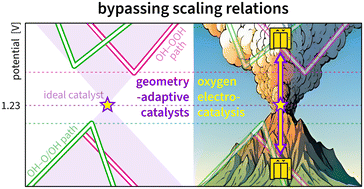
This communication introduces the concept of geometry-adaptive electrocatalysis, where a catalyst adjusts its geometry during the reaction. A model system of metal–nitrogen–carbon (M–N–C) catalysts – the dual-atom site 2Co–N4 of variable curvature – proves the concept from the first principles. Density functional theory calculations show how cycling the curvature effect with a geometry adaptation bypasses the scaling relations. Thus, in theory, geometry-adaptive electrocatalysis offers a promising direction to address the current stagnation in the experimentally measured overpotential for oxygen evolution and reduction reactions. It also indicates the possibility of discovering the ideal oxygen electrocatalyst.
 Please wait while we load your content...


