


 PLATFORM UPDATE:

One-step synthesis of a dual-functional AIE-active probe for ClO− detection and photodynamic therapy†
Xiaoyong
Zhang  *a
and
Yen
Wei
*c
*a
and
Yen
Wei
*c
*a
and
Yen
Wei
*c
Abstract
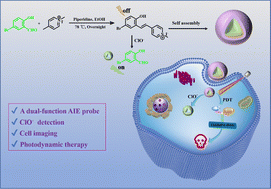
An amphiphilic fluorescent probe (BHSMP) with aggregation-induced emission (AIE) features was synthesized via a one-step route. The probe showed high water dispersibility, low toxicity and the ability of selective and sensitive (limit of detection of 0.11 µM) detection of ClO− with fast-response (≤30 s) in aqueous solution and living organisms. Owing to the donor–acceptor (D–A) structure and existence of cationic groups, BHSMP could also generate reactive oxygen species under light-irradiation and potentially be utilized for photodynamic therapy. The strategy described in this work is of great significance for the design and synthesis of multifunctional AIE-active functional materials to facilitate their biomedical applications.
 Please wait while we load your content...


