


 PLATFORM UPDATE:


Material design for converting an oxidative-type BiVO4 catalyst into a reductive BiV(S,O)4−x sulfo-oxide catalyst for nitrogen photoreduction to ammonia†

Abstract
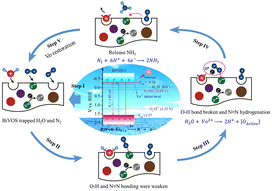
Herein, we demonstrated S2− anion incorporation into BiVO4 for converting an oxidative-type BiVO4 photocatalyst into a reductive-type BiV(S,O)4−x (labeled BiVOS) sulfo-oxide photocatalyst for efficient N2 fixation under an ambient environment. BiVOS-2 not only exhibited the highest NH3 production rate of 563.6 μmol g−1 h−1 without sacrificial agents and with durable stability but also had an apparent quantum efficiency (AQE) of 2.18% at 420 nm and a solar-to-ammonia (STA) conversion efficiency of 0.071% in pure water under AM1.5G light irradiation. At the same time, the sulfur-free BiVO4 can't realize N2 to NH3 conversion. The S2− doping introduced Vo, which converted V5+ around Vo into V4+ to keep the electrical neutrality. The active atoms V4+ were exposed and activated N2, and the electron hopping between V5+ and V4+ improved electron transfer. Density functional theory (DFT) calculation indicates that S2− anion doping can enhance adsorption energy, elongate the N![[triple bond, length as m-dash]](https://www.rsc.org/images/entities/char_e002.gif) N bond of the adsorbed N2 molecule, and facilitate electron transfer to the antibonding orbital of the N2 molecule, leading the BiVOS sulfo-oxide catalyst to have excellent N2 fixation activity. This study provides a promising method for converting an oxidative-type catalyst into a reductive catalyst to extend material applications.
N bond of the adsorbed N2 molecule, and facilitate electron transfer to the antibonding orbital of the N2 molecule, leading the BiVOS sulfo-oxide catalyst to have excellent N2 fixation activity. This study provides a promising method for converting an oxidative-type catalyst into a reductive catalyst to extend material applications.
 Please wait while we load your content...


