


 PLATFORM UPDATE:

Unveiling and overcoming the interfacial degradation between CuSCN and metal electrodes in perovskite solar cells†
 ab
and
Xuegong
Yu
*ab
ab
and
Xuegong
Yu
*ab
Abstract
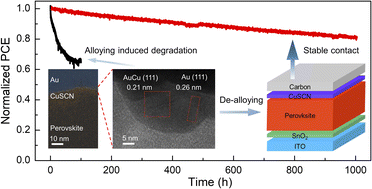
Copper(I) thiocyanate (CuSCN) is an extremely cheap and intrinsically stable p-type hole transport material which is attractive for solar cell applications. However, its devices exhibit poor stability due to the severe degradation at the CuSCN/metal-electrode interface and the origin is still unclear. Herein, the underlying degradation mechanism at CuSCN/metal (including Au, Ag and Al) interfaces is well unveiled, and metal electrodes induce the self-disproportionation reaction of Cu+ in CuSCN (Cu+ = Cu0 + Cu2+) through the alloying of Cu/metal, contributing to the interfacial degradation. This process in devices is spontaneous and sharply accelerated under the electric field, namely actual operation state. Thus, the metal electrode was replaced by a chemically stable carbon electrode to overcome the interface degradation, enabling efficient and stable n–i–p perovskite solar cells. Our finding uncovers the secret of degradation at the CuSCN/metal-electrode interface and provides an insight into the potential application of CuSCN in photoelectric devices, especially in solar cells.
 Please wait while we load your content...


