


 PLATFORM UPDATE:

A benzimidazole-derived fluorescent chemosensor for Cu(ii)-selective turn-off and Zn(ii)-selective ratiometric turn-on detection in aqueous solutions†
 *a
and
Xuan
Zhang
*ab
*a
and
Xuan
Zhang
*ab
Abstract
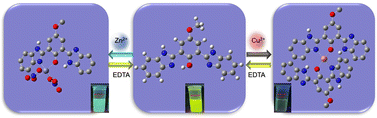
A 2,6-dibenzoimidazolyl-4-methoxyphenol conjugate (BBMP) was designed and synthesized to develop a novel fluorescent chemosensor for Cu2+ and Zn2+. The as-fabricated BBMP showed an excited-state intramolecular proton-transfer (ESIPT) fluorescence emission at 542 nm that was selectively and efficiently quenched by Cu2+ in a Tris-HCl solution (70% THF, pH = 7.4) due to the inhibition of ESIPT upon binding to metal ions. In contrast, the addition of Zn2+ not only resulted in a substantial decline in the original ESIPT fluorescence of BBMP but was also accompanied by the appearance of a new blue fluorescence emission at 462 nm. This indicated the potential for the present BBMP as a novel fluorescent probe for Cu2+ (turn-off) and Zn2+ (ratiometric turn-on) detection in aqueous solutions. The linear range and detection limit were found to be 0–5 μM and 0.16 μM for Cu2+, as well as 0–10 μM and 0.1 μM for Zn2+, respectively. A 2 : 1/1 : 1 coordination mode between BBMP and Cu2+/Zn2+ was confirmed by Job plots and mass analysis. Potential practical applications were also demonstrated by the analysis of real water samples and living cell imaging.
 Please wait while we load your content...


