


 PLATFORM UPDATE:

Dual S-scheme ZnO–g-C3N4–CuO heterosystem: a potential photocatalyst for H2 evolution and wastewater treatment
 *a
*a
Abstract
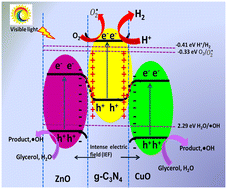
S-scheme heterojunctions have acquired rapid momentum in designing novel photocatalysts with prolonged separation of photocarriers while preserving exceptional redox ability, fascinating the scientific community. Herein, a simple solution combustion approach is used to design a ternary ZnO–g-C3N4–CuO heterojunction photocatalyst that is used in photocatalytic H2 evolution and degradation of MB and RhB. The maximum rate of MB degradation occurs at 100% under visible light for 35 min, which is noticeably higher than the RhB degradation rate (90%) under identical conditions. According to the trapping experiment, holes and ˙OH radicals are the primary oxidizing species that degraded MB and RhB. In comparison to pure ZnO, ZnO–CuO, and ZnO–g-C3N4 photocatalysts, the ternary ZnO–g-C3N4–CuO composite exhibits an ideal H2 evolution rate of 17.55 mmol−1 h−1 under visible light, which is approximately 42, 1.75, and 1.4 times superior, respectively. Besides, the strongest ZnO–g-C3N4–CuO composite undergoes five consecutive runs of stability test, and only a 3% decrease in H2 evolution after those tests reveals the photocatalyst's strong stability. The various analyses reveal that a dual S-scheme photocarrier transfer mode is produced at the interface of the ZnO–g-C3N4–CuO composite, providing outstanding separation of photocarriers. In the domain of photocatalysis, the design of this research can provide new insights into designing efficient heterojunction photocatalysts with diverse application potential.
 Please wait while we load your content...


