


 PLATFORM UPDATE:

Carboxamide and carbamate substituted π-conjugated polymers: the effect of hydrogen bonding on photovoltaic properties†
 *b
and
Qing
Zhang
*a
*b
and
Qing
Zhang
*a
Abstract
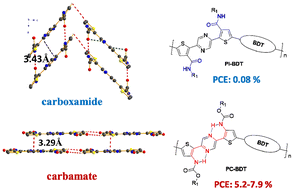
Thiophene–pyrazine–thiophene building blocks with carboxamide or carbamate substituents were synthesized and their crystal structures were compared. The carboxamide substituted building block formed intermolecular hydrogen bonds. It showed a twisted conformation and a herringbone packing in a single crystal. The carbamate substituted building block formed intramolecular resonance-assisted hydrogen bonds (RAHBs) and the hydrogen bonds enabled a co-planar structure, an extended π-conjugation, and a tight lamellar arrangement in a single crystal. Conjugated polymers based on these two building blocks were also synthesized. The hydrogen bonding caused significant differences in the optical, redox, and photovoltaic properties of the polymers. Solar cells based on the polymers as electron donors and Y6 as the acceptor were studied. The devices based on PC-BDT2 which had the intramolecular hydrogen bonds showed a power conversion efficiency (PCE) of 7.9%, while the devices based on PI-BDT which possessed the intermolecular hydrogen bonds gave a PCE of 0.1%.
 Please wait while we load your content...


