


 PLATFORM UPDATE:

Terminal substituent-induced differential aggregation and sensing properties: A case study of neutral benzimidazole-based urea receptors†

Abstract
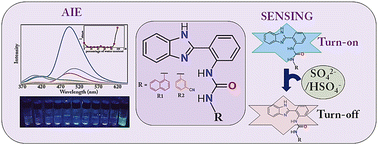
Two neutral benzimidazole-based urea receptors R1 and R2 with varying functional groups led to changes in aggregation as well as chemosensing properties. While R1 displayed aggregation-induced emission (AIE) properties by showing the highest emission in water against binary solvent switching, R2, on the other hand, showed typical aggregation-caused quenching (ACQ) behaviour. Both R1 and R2, however, could sense SO42−/HSO4− in an aqueous medium although with different binding affinities, the mechanistic details of which are investigated with the help of different spectroscopic, microscopic, and theoretical approaches.
 Please wait while we load your content...


