


 PLATFORM UPDATE:

Confined oriented growth of FeSe2 on a porous graphene film as a binder-free anode for high-rate lithium-ion batteries†
 a
Hongkun
Zhang
*bc
and
a
Hongkun
Zhang
*bc
and
Abstract
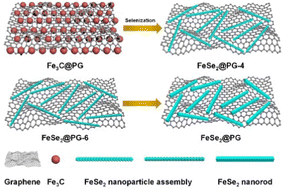
FeSe2 nanorod@porous graphene films (FeSe2@PG) were prepared by simple vacuum filtration, annealing, and subsequent selenylation. These FeSe2 nanorods were formed via confined oriented growth of FeSe2 nanoparticles. The morphology of FeSe2@PG was characterized using scanning electron microscopy (SEM) and transmission electron microscopy (TEM). The interfacial interaction between FeSe2 and graphene was investigated using X-ray photoelectron spectroscopy (XPS) and Raman spectroscopy. When used as an anode in lithium-ion batteries, the FeSe2@PG electrode exhibited an initial reversible capacity of 858 mA h g−1, which was increased to 1053 mA h g−1 after 50 cycles at 100 mA g−1. At high rates of 1, 2, 5, and 10 A g−1, the electrode maintained specific capacities of 483, 313, 265, and 178 mA h g−1, respectively, even after 1000 cycles. The excellent electrochemical performance of the FeSe2@PG electrode is attributed to the special structure of FeSe2@PG and the strong covalent bonds between graphene and FeSe2. Moreover, graphene can not only act as a substrate for the growth of FeSe2 nanorods, but also improve the conductivity of FeSe2. Furthermore, the porous structure of graphene can reduce the diffusion path of lithium ions and improve the penetration of the electrolyte into the graphene layer. In addition, a new covalent bond of C–Se–Fe was formed between graphene and FeSe2, which was beneficial for maintaining its structural stability.
 Please wait while we load your content...


