


 PLATFORM UPDATE:

Photoelectrochemical NADH regeneration on a polymer semiconductor-based photocathode†
 *a
and
Bingging
Zhang
*ab
*a
and
Bingging
Zhang
*ab
Abstract
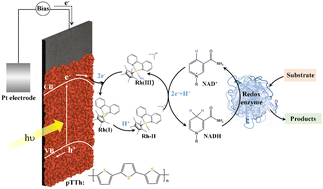
As an efficient electron and proton donor, reduced nicotinamide adenine dinucleotide (NADH) coenzyme holds great promise in the enzymatic industry; however, the high cost of NADH regeneration and its stoichiometric consumption in the catalytic process hinders its widespread application. Inspired by the process of natural photosynthesis, we report a green photoelectrochemical (PEC) strategy to realize NADH regeneration on a polyterthiophene (pTTh) semiconductor by using water and solar energy as reaction sources. The pTTh shows an unprecedentedly positive onset potential of 0.6 V vs. RHE for achieving an enzymatically active product of 1,4-NADH under simulated sunlight illumination. When operating the reaction at 0.1 V vs. RHE for 3 h, 2.8 mM 1,4-NADH can be generated, and the turnover frequency (TOF) is determined to be 3.73 h−1. Besides, the produced 1,4-NADH can be in situ employed to assist glutamate dehydrogenase in catalyzing α-ketoglutarate to produce L-glutamate. This study demonstrates a sustainable pathway to produce high value-added NADH on a polymer semiconductor by converting solar energy.
 Please wait while we load your content...


