


 PLATFORM UPDATE:


CH bond activation in aromatic ketones mediated by iridium-tris(pyrazolyl)borate complexes†
 *a
D.
Mendoza-Espinosa,
*a
C.
Cristobal,
b
M. C.
Ortega-Alfaro,
c
A.
Suárez
d
and
*a
D.
Mendoza-Espinosa,
*a
C.
Cristobal,
b
M. C.
Ortega-Alfaro,
c
A.
Suárez
d
and
Abstract
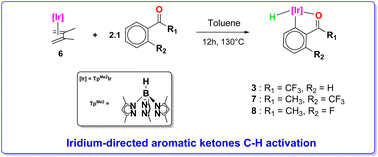
Reaction of complex [TpMe2Ir(η4-CH2![[double bond, length as m-dash]](https://www.rsc.org/images/entities/char_e001.gif) C(Me)C(Me)C2)] (1) with a series of aromatic ketones at 130 °C renders, by means of a selective ortho-CH activation, Ir(III)-metallacycles 2–5, which display an Ir–H bond. When [TpMe2Ir(C6H5)2N2] (6) is treated with 2-(trifluoromethyl)acetophenone and 2-fluoroacetophenone at 80 °C, the formation of dimeric (7) and trimeric architectures (8) is achieved through the meta- and para-CH activation of the aromatic ketone, respectively. The generation of complexes 2–5 is proposed to occur by the initial formation of Ir(III) η1-ketone adducts as key intermediates, followed by aromatic CH activations and the release of a butadiene ligand. The formation of complexes 7 and 8 involves an assisted process in which a metal center activation of the less sterically hindered C–H bond of the aromatic ketone takes place (releasing a benzene molecule), followed by the coordination of the carbonyl group, which generates the respective dimeric and trimeric structures. Complexes 7 and 8 are efficient catalysts for the transfer hydrogenation of ketones and aldehydes using isopropanol as the hydrogen source. All complexes have been fully characterized by NMR spectroscopy, FT-IR, elemental analysis and, in the cases of 7 and 8, X-ray crystallography. Details of the reaction conditions, isolation of the products, and proposals for the pathways of formation of complexes 2–5 and 7–8 are discussed.
C(Me)C(Me)C2)] (1) with a series of aromatic ketones at 130 °C renders, by means of a selective ortho-CH activation, Ir(III)-metallacycles 2–5, which display an Ir–H bond. When [TpMe2Ir(C6H5)2N2] (6) is treated with 2-(trifluoromethyl)acetophenone and 2-fluoroacetophenone at 80 °C, the formation of dimeric (7) and trimeric architectures (8) is achieved through the meta- and para-CH activation of the aromatic ketone, respectively. The generation of complexes 2–5 is proposed to occur by the initial formation of Ir(III) η1-ketone adducts as key intermediates, followed by aromatic CH activations and the release of a butadiene ligand. The formation of complexes 7 and 8 involves an assisted process in which a metal center activation of the less sterically hindered C–H bond of the aromatic ketone takes place (releasing a benzene molecule), followed by the coordination of the carbonyl group, which generates the respective dimeric and trimeric structures. Complexes 7 and 8 are efficient catalysts for the transfer hydrogenation of ketones and aldehydes using isopropanol as the hydrogen source. All complexes have been fully characterized by NMR spectroscopy, FT-IR, elemental analysis and, in the cases of 7 and 8, X-ray crystallography. Details of the reaction conditions, isolation of the products, and proposals for the pathways of formation of complexes 2–5 and 7–8 are discussed.
 Please wait while we load your content...


