


 PLATFORM UPDATE:

Organometallic Ir(iii) complexes: post-synthetic modification, photophysical properties and binuclear complex construction†‡
 a
Mariia
Ivonina,
d
Vladimir
Sizov,
b
Dar'ya
Spiridonova,
e
Denis
Vyalikh
gh
and
Elena
Grachova
*b
a
Mariia
Ivonina,
d
Vladimir
Sizov,
b
Dar'ya
Spiridonova,
e
Denis
Vyalikh
gh
and
Elena
Grachova
*b
Abstract
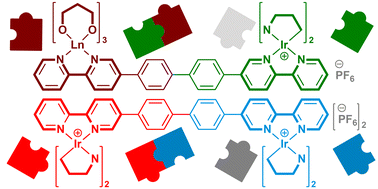
Two methods of post-synthetic modification (Suzuki coupling and CuAAC click-reaction) were applied to Ir(III) complexes [Ir(C^N)2N^N]+ to provide the second highly selective donor site. One family of functionalized complexes was used to demonstrate the potential of post-synthetic modification for controlled construction of d–d and d–f binuclear complexes. The complexes obtained were characterized by CHN elemental analysis, NMR spectroscopy, ESI mass-spectrometry, FTIR spectroscopy and single crystal X-ray diffraction analysis. By means of XPS and NEXAFS spectroscopy the coordination of diimine donor site to the Ln(III) centre has been definitely confirmed. The photophysical properties of mono- and binuclear complexes were carefully investigated, and the evolution of luminescent characteristics during the formation of a system of connected metallocenters is also discussed. TDDFT calculations were used to describe the luminescence mechanism and to confirm the conclusions made on the basis of experimental data.
 Please wait while we load your content...


