


 PLATFORM UPDATE:

Accelerated H2 activation over Pt/M-ZrO2 for the reductive amination of levulinic acid esters under benign conditions†

Abstract
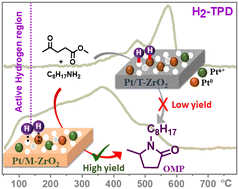
Catalytic reductive amination of biomass-derived levulinic acid and its esters to pyrrolidones, having numerous applications in the pharmaceutical and agrochemical fields, is an attractive approach. A robust Pt-impregnated monoclinic ZrO2 (Pt/M-ZrO2) catalyst is developed for the reductive amination of methyl levulinate (MLevu) with octyl amine (OA) in the presence of H2, obtaining a quantitative yield of N-octyl-5-methyl-2-pyrrolidones (OMP) at ambient temperature. Adversely, Pt-impregnated tetragonal ZrO2 (Pt/T-ZrO2) displays an 18-fold lower activity than Pt/M-ZrO2 in terms of turnover frequency at similar conversion. Transmission electron microscopy with energy dispersive X-ray (TEM-EDX) spectroscopy suggests higher Pt dispersion in Pt/M-ZrO2, having a 15-fold higher surface area than Pt/T-ZrO2, as evidenced by N2-sorption analysis. Pt/M-ZrO2 contains 15 and 2-fold more acidic and basic sites than Pt/T-ZrO2, respectively, which helps to activate the C![[double bond, length as m-dash]](https://www.rsc.org/images/entities/char_e001.gif) N bond of the formed intermediate and H2, thus facilitates hydrogenation to form OMP selectively. Further, the poisoning studies reveal that both acidic and basic sites in Pt/M-ZrO2 play a vital role in enhancing the yield of OMP, indicating the formation of a frustrated Lewis pair (FLP) that facilitates the reaction at room temperature. Moreover, H2-temperature programmed desorption (H2-TPD) evidently supports that Pt/M-ZrO2 possesses a low-temperature desorption peak (50–100 °C), which is absent in the case of Pt/T-ZrO2, indicating high H2 activation and hydrogenation ability at room temperature which significantly contributes to hydrogenation of the formed imine intermediate to OMP. Further, Pt/M-ZrO2 is recyclable for at least three times with no significant changes in the conversion and yield.
N bond of the formed intermediate and H2, thus facilitates hydrogenation to form OMP selectively. Further, the poisoning studies reveal that both acidic and basic sites in Pt/M-ZrO2 play a vital role in enhancing the yield of OMP, indicating the formation of a frustrated Lewis pair (FLP) that facilitates the reaction at room temperature. Moreover, H2-temperature programmed desorption (H2-TPD) evidently supports that Pt/M-ZrO2 possesses a low-temperature desorption peak (50–100 °C), which is absent in the case of Pt/T-ZrO2, indicating high H2 activation and hydrogenation ability at room temperature which significantly contributes to hydrogenation of the formed imine intermediate to OMP. Further, Pt/M-ZrO2 is recyclable for at least three times with no significant changes in the conversion and yield.
 Please wait while we load your content...


