


 PLATFORM UPDATE:

Magnetocaloric effect and magnetic ordering in GdFe1−xTxSi, T = Cr, V, Ni
 *a
*a
Abstract
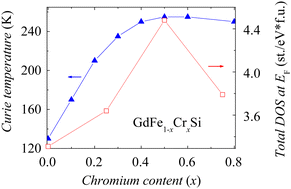
The intermetallic compounds GdFe1−xCrxSi, x = 0–0.8, GdFe1−xVxSi, x = 0–0.4, and GdFe1−xNixSi, x = 0–0.4 with a tetragonal CeFeSi (P4/nmm) structure type have been synthesized. The Curie temperature, TC, sharply increases from 130 K to 255 K and 250 K for the GdFe1−xCrxSi and GdFe1−xVxSi compounds and decreases to 104 K for GdFe1−xNixSi. Within the framework of the model of effective d–f exchange interaction in R![[3 with combining macron]](https://www.rsc.org/images/entities/char_0033_0304.gif) d intermetallics, these changes in TC can be caused by the corresponding changes in the density of states. The electronic structure, magnetic moments and types of magnetic orderings of the GdFe1−xTxSi, T = Cr, V, Ni intermetallic compounds were calculated using the DFT+U theoretical method. For the GdFe1−xNixSi system, the transformation of a ferromagnet with the composition x = 0 into an antiferromagnet with the composition x = 0.3 was established experimentally and using first-principles calculations. The correlation of the ferromagnetic or antiferromagnetic type of the magnetic state in the GdFe1−xNixSi compounds with the value of the lattice parameter c to greater or less than the critical value c = 6.72 Å for the GdCoSi antiferromagnet has been experimentally established. The magnetic structures of the antiferromagnets GdFe0.7Ni0.3Si and GdCoSi were found to be different. GdFe0.7Ni0.3Si is characterized by a collapse in the magnetocaloric effect via a change in the isothermal magnetic entropy ΔSM(TC). The compounds GdFe0.4Cr0.6Si with −ΔSM(TC) = 2.37 J kg−1 K−1 at TC = 255 K and RC = 82.07 J kg−1 and GdFe0.7V0.3Si with −ΔSM(TC) = 2.06 J kg K−1 at TC = 250 K and RC = 96.02 J kg−1 in a field changing to 17 kOe could be of practical interest due to the TC being close to room temperature.
d intermetallics, these changes in TC can be caused by the corresponding changes in the density of states. The electronic structure, magnetic moments and types of magnetic orderings of the GdFe1−xTxSi, T = Cr, V, Ni intermetallic compounds were calculated using the DFT+U theoretical method. For the GdFe1−xNixSi system, the transformation of a ferromagnet with the composition x = 0 into an antiferromagnet with the composition x = 0.3 was established experimentally and using first-principles calculations. The correlation of the ferromagnetic or antiferromagnetic type of the magnetic state in the GdFe1−xNixSi compounds with the value of the lattice parameter c to greater or less than the critical value c = 6.72 Å for the GdCoSi antiferromagnet has been experimentally established. The magnetic structures of the antiferromagnets GdFe0.7Ni0.3Si and GdCoSi were found to be different. GdFe0.7Ni0.3Si is characterized by a collapse in the magnetocaloric effect via a change in the isothermal magnetic entropy ΔSM(TC). The compounds GdFe0.4Cr0.6Si with −ΔSM(TC) = 2.37 J kg−1 K−1 at TC = 255 K and RC = 82.07 J kg−1 and GdFe0.7V0.3Si with −ΔSM(TC) = 2.06 J kg K−1 at TC = 250 K and RC = 96.02 J kg−1 in a field changing to 17 kOe could be of practical interest due to the TC being close to room temperature.
 Please wait while we load your content...


