


 PLATFORM UPDATE:


Naphthalenediimide-based nanoarchitectonics for a fluorescent chemosensor with highly selective and sensitive detection of cyanide ions†

Abstract
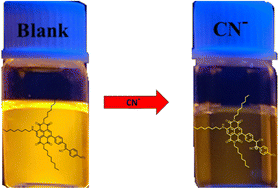
A naphthalenediimide (NDI)-based highly potential chemosensor for the detection of cyanide has been synthesized successfully in several steps. The NDI-based probe displayed high selectivity and sensitivity towards cyanide ions in fluorescence ‘turn-off’ mode over other ions used in this study. The naked-eye, UV-vis absorbance and fluorescence methods are employed to investigate the sensing performance of probe 1 toward CN− ion detection. The limit of detection for CN− ions was calculated to be 4.11 × 10⁻⁷ M. Moreover, the Stern–Volmer quenching constant and fluorescence quenching efficiency of CN− ions were estimated to be 1.1 × 10⁵ M and 88.81%, respectively. Job's plot showed a 1 : 1 stoichiometric complexation reaction between probe 1 and CN− ions. For practical applications, probe 1 was efficiently applied for the detection of CN− ions using a paper strip method.
 Please wait while we load your content...


