


 PLATFORM UPDATE:

Preparation and application of high-brightness red carbon quantum dots for pH and oxidized l-glutathione dual response†
 *ac
and
Li
Li
*acd
*ac
and
Li
Li
*acd
Abstract
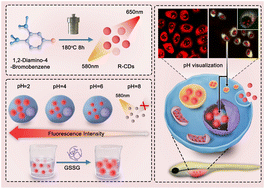
Carbon dots (CDs) with red fluorescence emission are highly desirable for use in bioimaging and trace- substance detection, with potential applications in biotherapy, photothermal therapy, and tumor visualization. Most CDs emit green or blue fluorescence, thus limiting their applicability. We report a novel fluorescent detection platform based on high-brightness red fluorescence emission carbon dots (R-CDs) co-doped with nitrogen and bromine, which exhibit pH and oxidized L-glutathione (GSSG) dual-responsive characteristics. The absolute quantum yield of the R-CDs was as high as 11.93%. We discovered that the R-CDs were able to detect acidic pH in live cells and zebrafish owing to protonation and deprotonation. In addition, GSSG was detected in vitro over a broad linear range (8–200 μM) using the R-CDs with excitation-independent emission. Furthermore, cell imaging and bioimaging experiments demonstrated that the R-CDs were highly cytocompatible and could be used as fluorescent probes to target lysosomes and nucleolus. These studies highlight the promising prospects of R-CDs as biosensing tools for bioimaging and trace-substance detection applications.
 Please wait while we load your content...


