


 PLATFORM UPDATE:


Interface engineering of calligraphic ink mediated conformal polymer fibers for advanced flexible supercapacitors†
 *a
and
*a
and
Abstract
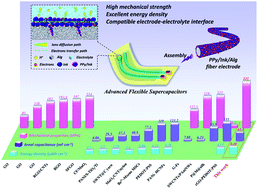
Bio-based fibers with excellent mechanical and electrochemical properties are crucial to construct high-performance fiber-shaped electrochemical supercapacitors (FESCs) for wearable applications. However, the available biofiber electrodes suffer greatly from the drawbacks of serious interface stability and mechanical durability. Herein, a novel interface engineering strategy was developed to simultaneously promote the mechanical and electrochemical properties of seaweed-derived alginate fibers for organic–inorganic–organic composite fiber electrodes. Utilizing calligraphic ink as a conformal interlayer, a universal scaffold with a hierarchical core–shell structure was formed for sufficiently depositing pseudocapacitive molecules on alginate fibers, which not only boosted the interface stability and mechanical durability, but also resulted in a pathway for effective electrolyte infiltration and accelerated ion diffusion and transfer. As expected, the conformal composite fiber electrode demonstrates an excellent areal capacitance of 1025.6 mF cm−2 and an ultrahigh mechanical strength of 321 MPa (17 times vs. GO-based composite fibers). The as-assembled symmetrical FESC device shows a high energy density of 5.49 μW h cm−2, surpassing most of the state-of-the-art symmetric FESCs based on synthetic fibers. This study provides a universal interface engineering strategy to promote the energy density of FESCs without sacrificing the mechanical strength, which is desirable for sustainable portable and wearable electronics.
 Please wait while we load your content...


