


 PLATFORM UPDATE:


High-performance piezoelectric nanogenerators featuring embedded organic nanodroplets for self-powered sensors†
 a
and
Sooman
Lim
*a
a
and
Sooman
Lim
*a
Abstract
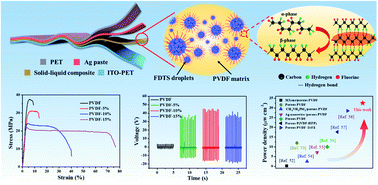
Piezoelectric nanogenerators with excellent electromechanical coupling effects are in great demand for self-powered Internet-of-Things (IoT) devices. In this work, a novel solid–liquid nanocomposite-based piezoelectric nanogenerator (SL-PENG) with unprecedented properties was developed by employing 1H,1H,2H,2H-perfluorodecyltriethoxysilane (FDTS) droplets as liquid fillers. Through the combination of solvent selection and solvent evaporation protocols, highly deformable FDTS nanodroplets with a controllable droplet size were uniformly distributed in a polyvinylidene fluoride (PVDF) matrix, thereby improving the toughness of the polymer matrix. FDTS nanodroplets form strong intermolecular hydrogen bonds with PVDF chains to promote the transformation of α-phase to polar β-phase, while stabilizing the liquid phase that prevents FDTS nanodroplets from fracture and exudation to a polymer network. The synergistic contribution of the β-phase content and stress transfer ability significantly improves the output performance of SL-PENG, which is proved by the experimental results and COMSOL simulation. Remarkably, this SL-PENG generates a maximum peak-to-peak voltage and current as high as 62 V and 3.2 μA, respectively, corresponding to a power density of 35 μW cm−2, which demonstrates remarkable superiority to other PENGs. Moreover, this SL-PENG is demonstrated as part of a monitoring device for the wireless sensor network, realizing the detection and response of physiological signals, and showing broad potential application prospects in the field of IoT.
 Please wait while we load your content...


