


 PLATFORM UPDATE:


Regeneration of pristine HZSM-5 extrudates during the production of deeply deoxygenated bio-oil from ex situ catalytic fast pyrolysis of biomass in a bench-scale fluidised-bed reactor
 b
and
Adisak
Pattiya
*a
b
and
Adisak
Pattiya
*a
Abstract
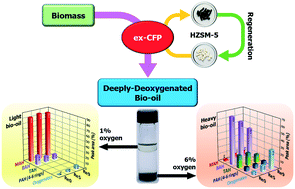
Ex situ catalytic fast pyrolysis (ex-CFP) of biomass applying ZSM-5 catalysts is an effective method for deoxygenating the pyrolysis vapour, thus producing low-oxygen bio-oil in a single step. The catalysts deactivate after reactions but can be regenerated to recover their performance. Most of the previous studies on catalyst regeneration applied modified ZSM-5 catalysts to produce partially deoxygenated bio-oil with an oxygen content of around 10–25 wt%. In the deep deoxygenation region with bio-oil oxygen content below 5 wt%, the regeneration of pristine HZSM-5 catalyst used in ex-CFP where filtered pyrolysis vapour is upgraded has not been elucidated. Therefore, it is the main purpose of the current study to demonstrate the deep-deoxygenation capability of an unmodified HZSM-5 catalyst that has been previously depreciated. In this work, eucalyptus wood was pyrolysed in a bench-scale bubbling fluidised-bed reactor close-coupled with a separate catalytic reactor containing a fixed bed of pristine HZSM-5 extrudates. The produced catalytic bio-oil appears in 3 phases: light bio-oil, medium aqueous phase and heavy bio-oil. The light bio-oil has a very low oxygen content of ∼1 wt%, containing mainly monocyclic aromatic hydrocarbons, especially benzene, toluene and xylene. The heavy liquid had an oxygen content of 5–8 wt%, containing mainly naphthalene derivatives. The average degree of deoxygenation achieved in this work was 91% throughout the 10 experiments using fresh and regenerated catalysts. The unmodified HZSM-5 extrudates can be considered regenerable for up to 9 cycles with minor catalyst deactivation. The yields of main products including total bio-oil, char and gas were unaffected by the catalyst regeneration. However, the yield of light bio-oil appeared to gradually decrease with regeneration cycles. The regenerated catalyst could retain its surface area, morphology and structural framework to a great extent, albeit with small changes occurring on the surface area and volume of the micropores as well as its crystallinity and crystalline size.
 Please wait while we load your content...


