


 PLATFORM UPDATE:


Main-chain/side-chain type phosphine oxide-containing reactive polymers derived from the same monomer: controllable RAFT polymerisation and ring-opening polycondensation†

Abstract
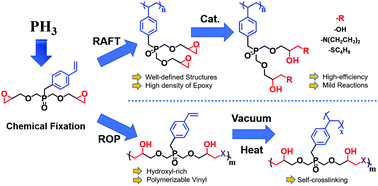
This paper reports the synthesis and selective polymerisations of an epoxy-rich phosphine oxide-containing styrenic monomer, namely 4-vinylbenzyl-bis((oxiran-2-ylmethoxy)methyl) phosphine oxide (VBzBOPO). The styryl and epoxy functionalities could be polymerized independently through free radical polymerisation or polycondensation without interference between the processes, and both resulted in reactive polymers with a high density of functional groups. In particular, reversible addition–fragmentation chain transfer polymerisation (RAFT) of VBzBOPO led to polyVBzBOPO with controlled molecular weights and narrow polydispersity (Đ = 1.13–1.23). Due to its high density of epoxy groups, polyVBzBOPO served as a precursor to a family of functionalized polymers, which were formed with a range of chemical reactions (post-polymerisation modifications) using various reagents (such as water, diethylamine, n-butanethiol and so on). Alternatively, the ring-opening polycondensation of VBzBOPO with difunctional monomers occurred via epoxy-thiol, epoxy-amine or epoxy-acid reactions that proceeded under mild conditions, and these furnished linear polymers with styryl and hydroxyl groups along the polymer chain. These polymers underwent self-crosslinking reactions at 60 °C under vacuum without any initiators, and this resulted from thermally initiated polymerisation of styrene. The water-uptake capacities of these cross-linked polymers were adjusted by changing the pH or adding a certain amount of H2O2. All the polymers were characterized in detail by Fourier transform infrared spectroscopy (FT-IR), nuclear magnetic resonance (NMR) spectroscopy and size exclusion chromatography (SEC).
 Please wait while we load your content...


