


 PLATFORM UPDATE:

Unravelling the intrinsic synergy between Pt and MnOx supported on porous calcium silicate during toluene oxidation†
 *abc
*abc
Abstract
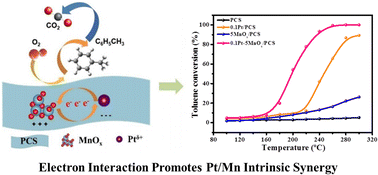
Developing efficient catalysts that enhance electronic interactions between active metal sites is a promising strategy for removing volatile organic compounds (VOCs). Herein, we report the preparation of a series of novel porous–calcium–silicate-supported (PCS-supported) Pt–MnOx bimetallic catalysts for the catalytic oxidation of toluene. The 0.1Pt–5MnOx/PCS catalyst showed excellent catalytic activity, exhibiting the lowest temperature (237 °C) for 90% toluene conversion (T90), the highest CO2 selectivity (94.29%), and excellent long-term stability and water resistance, which is primarily ascribable to strong electronic interactions between Pt and MnOx species. Partial electron transfer from MnOx to Pt through Pt–O–Mn bonds results in the formation of electron-rich Pt0 and Mn4+ species, thereby improving the active oxygen species content and enhancing low-temperature reducibility. The in situ DRIFTS technique proved that the possible reaction path of toluene combustion is toluene → benzaldehyde → benzoic acid → maleic anhydride → carbon dioxide and water. This study is expected to provide new insight into the relationship between electronic interactions and the catalytic performance of bimetallic catalysts toward VOCs.
 Please wait while we load your content...


