


 PLATFORM UPDATE:

A DFT study of NHC-catalyzed reactions between 2-bromo-2-enals and acylhydrazones: mechanisms, and chemo- and stereoselectivities†
 *a
Zhiqiang
Zhang
a
*a
Zhiqiang
Zhang
a
Abstract
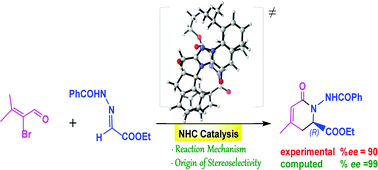
The mechanistic features, and chemo- and stereoselectivities of the [4 + 2] cycloaddition between 2-bromo-2-enal and acylhydrazone catalyzed by a chiral N-heterocyclic carbene (NHC) catalyst were derived from density functional theory calculations. In the energetically most favored pathway, the activation of 2-bromo-2-enal by the NHC catalyst occurs first, followed by a proton transfer promoted by HCO3−, and the resulting Breslow intermediate then undergoes successive debromination and HCO3−-mediated proton transfer leading to an acylazolium ion, which in turn undergoes γ-deprotonation to yield the vinyl enolate intermediate. The next crucial step is the [4 + 2] cycloaddition and affords the six-membered zwitterionic intermediate, which upon expulsion of NHC provides access to (R)-δ-lactam. The computational results are in good agreement with the experimental observations. Distortion/interaction and non-covalent interaction (NCI) analyses were conducted to disclose the origins of the stereoselectivity. Furthermore, global reactivity indexes (GRIs) analysis was also performed to investigate the role of NHC.
 Please wait while we load your content...


