


 PLATFORM UPDATE:

Controlled compositions of tellurium/vanadium co-doped into hydroxyapatite/ε-polycaprolactone for wound healing applications
 *ab
and
*ab
and
Abstract
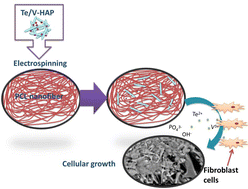
Hydroxyapatite (HAP) was co-doped with tellurium and vanadium ions via the co-precipitation method. Pure HAP nanoparticles were embedded through polymeric materials, such as polycaprolactone (PCL), to improve and upgrade their functionality. The PCL/HAP scaffold nanofiber has been successfully prepared using the electrospinning method and analyzed including nanostructure, surface roughness, and tensile strength. The roughness increased from 37.6 to 71.4 nm through a powdered phase, while it developed from 54.1 to 114.4 nm for the nanofibrous membranes. Furthermore, the mechanical behavior has been studied and showed a progression upon the addition of Te ions from 7.45 ± 0.8 to 10.38 ± 1.4 MPa in tensile strength. The contact angle was measured. It was reduced, indicating the modification of hydrophilicity of pristine PCL. The angle values decreased from 105.4 to 88.5° within the nanofibrous scaffolds. The scaffolds were cultured with the fibroblast cell line for three days, whereas the cells proliferated and grew through the scaffolds considerably.
 Please wait while we load your content...


