


 PLATFORM UPDATE:

Diverse “roof shaped” chiral diamidophosphites: palladium coordination and catalytic applications†
 *a
Ilya V.
Chuchelkin,
a
Vladislav K.
Gavrilov,
a
Ilya D.
Firsin,
a
Nataliya S.
Goulioukina
abc
*a
Ilya V.
Chuchelkin,
a
Vladislav K.
Gavrilov,
a
Ilya D.
Firsin,
a
Nataliya S.
Goulioukina
abc
Abstract
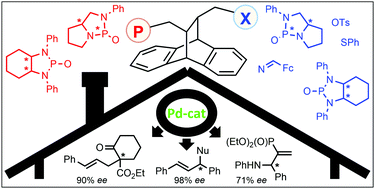
A series of diamidophosphite ligands of various structures and denticities were synthesized from (11S,12S)-bis(hydroxymethyl)-9,10-dihydro-9,10-ethanoanthracene as a “roof shaped” 1,4-diol. On the basis of these ligands, we obtained three types of Pd(II) allylic complexes: a P,P-chelate, a P,S-bridged head-to-tail dinuclear complex, and complexes each containing a pair of P-monodentately coordinated P-, P,N- or P,S-ligands. The structures of the ligands and their complexes were determined using 2D NMR spectroscopy. Four diamidophosphites were also characterized via their X-ray structural data. This kind of stereoselector exhibited up to 98% ee in the Pd-mediated allylic substitution of (E)-1,3-diphenylallyl acetate with C- and N-nucleophiles. In the Pd-catalyzed allylic alkylation of cinnamyl acetate with various C-nucleophiles, ee values of up to 90% were obtained. In addition, up to 71% ee was achieved in the Pd-catalyzed asymmetric amination of 2-(diethoxyphosphoryl)-1-phenylallyl acetate with aniline, which is a pioneering example of diamidophosphite-type ligand involvement in this challenging reaction. The effects of the diamidophosphite moiety and the denticity of the ligands on the catalytic activity and enantioselectivity were investigated.
 Please wait while we load your content...


