


 PLATFORM UPDATE:


Superatomic salts with controlled ionicity†
 a
and
Shiv N.
Khanna
*a
a
and
Shiv N.
Khanna
*a
Abstract
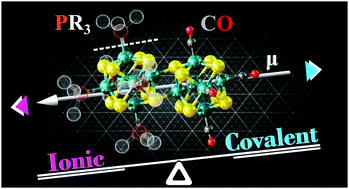
We propose a new class of superatomic molecules where the bonding characteristics between two identical superatoms can be modified by using suitable ligands around metal-chalcogen clusters. We demonstrate these intriguing findings by considering the Rh6S8Ln class of superatoms. Our choice of ligands (L) is motivated by the condition that the ligand binds to the metal-chalcogen core via the same atom while the electronegativity of the ligand is altered by attaching various units to this connecting atom. For this purpose, we have chosen the phosphine ligands (PR3, R = functional groups) where the electronegativity of the ligands is changed via the functional (R) group ranging from NMe2 to F. It is also observed that this technique can be further used to induce controllable electronic features in the (PR3)5Rh6S8–Rh6S8(CO)5 series of dimers/salts. The differences in the location of electronic levels on the two sides result in internal charge transfer that not only adds an ionic component to bonding over the covalent component but also leads to dipole moments/internal electric field in an otherwise homo-cluster dimer. Thus, the strength of the dipole moment/internal field of the dimer can be adjusted by changing the electronegativity of the PR3 group offering a unique opportunity of making cluster assembled solids using superatomic molecules with adjustable dipolar strength, internal fields, and location of HOMO/LUMO, useful for various applications including light-harvesting.
 Please wait while we load your content...


