


Ion-bearing stairs: alkali metal complexes of 1,2-diaza-4-phospholides†

Abstract
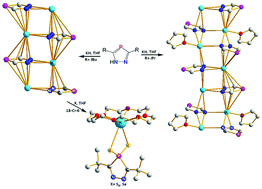
In this work, eight alkali metal complexes with 1,2-diaza-4-phospholide ligands were prepared and characterized by X-ray single-crystal structural analysis and NMR spectroscopy. Their structures showed varied coordination motifs: (i) a dimeric 1,2-diaza-4-phospholide lithium complex with exo-bidentate bridging coordination (4) consists of two lithium atoms that are linked via two μ2-bridging, κN,κN′-coordinated ligands; (ii) the polymeric chain 1,2-diaza-4-phospholide potassium complex (5) showed an ion-bearing stair-shaped chain structure running through axis a, where the steps are η2 interactions, and there is a transition platform between every two stairs; (iii) the polymeric chain 1,2-diaza-4-phospholide potassium complex (6) also presented a polymeric chain structure in the solid state but displayed a head-to-tail arrangement of two 1,2-diaza-4-phospholides; (iv) in comparison to 6, the 1,2-diaza-4-phospholide sodium complex (7) displayed a tetrameric structure, in which the sodium ions are arranged in a distorted tetrahedral fashion and each of them occupies a vertex of the tetrahedron; (v) the polymeric chain 1,2-diaza-4-phospholide potassium complex (8) presented a solvent-free chain structure, in which potassium ions each is η5-bonded by two 1,2-diaza-4-phospholides and η2-coordinated by another, consisting of a stair-shaped chain structure running through axis a but without significant intermolecular contacts between the adjacent stairs in comparison to that of 5; (vi) the polymeric chain 1,2-diaza-4-phospholide sodium complex (9) presented a solvent-free chain structure, in which sodium ions each is η1(N),η2(N,N),η1(P)-bonded by three 1,2-diaza-4-phospholides, consisting of a chain structure running through axis a; and (vii) the treatment complex 8 with elemental sulphur or selenium in the presence of crown ether gave rare thiophosphonato potassium [η3(S,P,S)-3,5-tBu2dp-(μ-K)(S2)([18]crown-6)] (10) or a selenophosphonato potassium [η3(Se,P,Se)-3,5-tBu2dp-(μ-K)(Se2)([18]crown-6)] (11). Both of the complexes crystallized in the orthorhombic space group Pnma as pale-yellow (or red) crystals. The X-ray diffraction analysis revealed 10 or 11 as a terminal complex with the η1,η1-X,X-coordination mode (X = S and Se). The 1H DOSY NMR spectroscopy study of the species 8 in DMSO-d6 suggested that polymeric complexes (4–9) in the solid state should dissociate into the related monomers in the solutions when the donor solvents were used.
 Please wait while we load your content...


