


 PLATFORM UPDATE:


Surface engineering of nanoporous silicon photocathodes for enhanced photoelectrochemical hydrogen production†
 *a
Qing-Xiao
Tong
*a
*a
Qing-Xiao
Tong
*a
Abstract
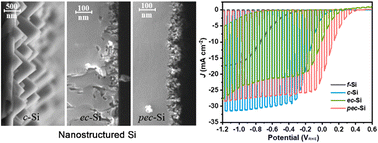
Silicon (Si) is a promising semiconductor material in photoelectrochemical (PEC) H2 evolution due to its advantages of being an earth-abundant element, non-toxicity, broad absorption of the solar spectrum, high saturation current and industrial fabrication. However, shortcomings such as strong sunlight reflection, low photocurrent onset potential, slow charge-transfer dynamics at the silicon/electrolyte interface, and low stability in electrolyte limit its PEC applications. In this work, surface-engineered nanoporous Si photocathodes with controllable surface morphologies were fabricated. Compared with flat Si (f-Si), chemically-etched Si (c-Si) and electrochemically-etched Si (ec-Si), PEC-etched Si (pec-Si) exhibits advantages such as high light-harvesting efficiency, a large surface area and improved electron-transfer, resulting in dramatically enhanced PEC water splitting. Additionally, n-type TiO2 is deposited on the Si surface to prepare a p–n heterojunction and a protective layer, which further increases the charge separation and water splitting stability. Under AM1.5G illumination, the optimized pec-Si/TiO2 photocathode gives a high photocurrent density of −15.53 mA cm−2 at 0 VRHE, a large onset potential of 0.60 VRHE, and a high applied bias photon-to-current efficiency of 2.22% for H2 production. The surface engineering of the nanoporous structures and p–n heterojunction brings insights into the construction of efficient photoelectrodes for solar conversion.
 Please wait while we load your content...


