


 PLATFORM UPDATE:

Visible-light-driven sustainable conversion of carbon dioxide to methanol using a metal-free covalent organic framework as a recyclable photocatalyst†
 b
and
Sk. Manirul
Islam
*a
b
and
Sk. Manirul
Islam
*a
Abstract
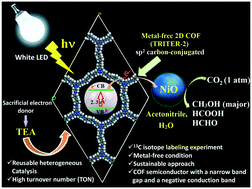
A new triazine-based organized 2D covalent organic framework (COF), namely, TRITER-2, was built through combinatorial copolymerization between 4,4′-biphenyldicarbaldehyde and a triamine 1,3,5-tris-(4-aminophenyl) triazine (TAPT). This highly crystalline organic polymeric material displayed a superior BET surface area (1260 m2 g−1) and exceptional photocatalytic activity for the synthesis of methanol. The metal-free catalytic reduction to methanol has emerged as a sustainable avenue due to the ambient reaction conditions by which CO2 is reduced to methanol. The catalytic reduction of CO2 under metal-free conditions offered the synthesis of methanol at a low price, in a non-toxic way with earth-abundant reagents, and a low carbon footprint. Using this COF TRITER-2, we have carried out the photocatalytic reduction of CO2 into high-value methanol as the active photo-catalyst under atmospheric pressure CO2. The highest turnover number (TON = 141) for visible-light-accelerated metal-free CO2 reduction to methanol (major product) using crystalline TRITER-2 (10 mg) was achieved under 20 W white LED irradiation. The reaction did not proceed without any applied potential (i.e., a white LED) and can be readily monitored by altering the light intensity. We demonstrate that a TON of about 10 can be reached with sunlight under sustainable reaction conditions. This catalyst is efficient, selective, and can be recycled several times, retaining its catalytic performance.
 Please wait while we load your content...


