


 PLATFORM UPDATE:

Sensitization of lanthanide complexes through direct spin-forbidden singlet → triplet excitation†

Abstract
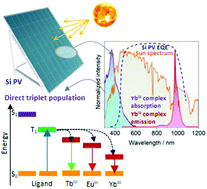
LnIII complexes may display luminescence within the ultraviolet-visible-near-infrared spectral window and although they render bright emissions mainly due to the classical singlet-triplet-state-assisted ligand sensitization, which would be the photophysical parameters if they could be excited through direct spin-forbidden singlet → triplet transitions? Herein, we report the sensitization of Ln complexes through spin-forbidden S0 → T transitions in a series of homobimetallic EuIII, TbIII, ErIII, and YbIII complexes with halogen-substituted benzoate ligands. As halogens and LnIII atomic numbers increase, intense singlet → triplet absorption/excitation bands and relative quantum yields up to 18% were achieved due to an increased spin–orbit coupling effect. Moreover, the near-UV-shifted excitation may enable application in luminescent solar concentrators where YbIII near-infrared luminescence matches the maximum efficiency of the crystalline Si photovoltaic cell. Therefore, the spin-relaxed excitation channel provides new opportunities to improve the LnIII complex luminescence and potential within the energy conversion field.
- This article is part of the themed collection: Celebrating Latin American Chemistry
 Please wait while we load your content...


