


 PLATFORM UPDATE:


Highly efficient synthesis of extremely fine nano-SnO2 photocatalytic materials by dealloying Cu50Sn50 alloy powders with mainly exposed {123} facts in η-Cu6Sn5

Abstract
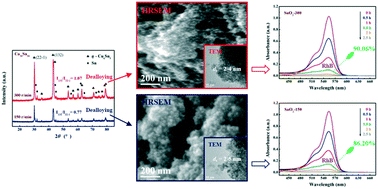
Extremely fine nano-SnO2 photocatalysts were successfully synthesized by a dealloying method using high-corrosion-activity Cu50Sn50 alloy powders as precursor materials. The results showed that the dealloying cycles for Cu50Sn50 precursors prepared by ball milling at 300 and 150 r min−1 could be significantly shortened to 2 and 2.5 h, respectively; among them, the Cu50Sn50 precursor prepared at 300 r min−1 involved a shorter period of time because the precursor prepared at 300 r min−1 exposed more unstable active crystal planes of {123} in η-Cu6Sn5 compared to the precursor prepared at 150 r min−1. The results also showed that the nano-SnO2 synthesized by dealloying Cu50Sn50 powders (which were prepared by ball milling at 300 and 150 r min−1) consisted of large quantities of tiny particles with very small sizes of 2.5–4 and 2.5–5 nm, respectively. In addition, the results from the photodegradation experiments showed that the nano-SnO2 synthesized by dealloying Cu50Sn50 alloy powders (which were prepared at 300 r min−1) displayed the best photocatalytic performance, thus suggesting that Cu50Sn50 powders with mainly exposed active facets are perfect precursor materials for the highly efficient dealloying synthesis of extremely fine nano-SnO2 with superior catalytic activity. This is the first time the influence of active crystal planes in the phase of precursors on the dealloying process has been investigated, which sets a good example for designing more ideal alloy systems with mainly exposed active crystal planes as precursors for the fast dealloying preparation of other novel photocatalysts.
 Please wait while we load your content...


