


 PLATFORM UPDATE:

Bioinspired self-cleaning surface with microflower-like structures constructed by electrochemically corrosion mediated self-assembly†

Abstract
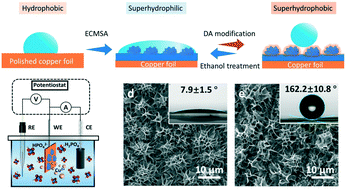
Developing facile and low-cost methods for the fabrication of bioinspired self-cleaning surfaces is of significant importance but still very challenging. In this work, we present a simple, facile and low-cost electrochemically corrosion mediated self-assembly (ECMSA) approach to construct microflower-like hierarchical structures for self-cleaning surfaces. The ECMSA enables tailoring of the surface with tunable microstructures by manipulating applied potentials and phosphate concentrations. The roles of different factors (e.g., potentials, reaction times and phosphate concentrations) are investigated, and a three-step growth mechanism of copper phosphate microflowers is then proposed. Due to the presence of –OH polar functional groups, the as-formed microflower-like surface exhibits superhydrophilicity with a water contact angle (WCA) of 7.9 ± 1.5°. After hydrophobic coating with dodecylamine, the as-prepared surface not only exhibits superhydrophobicity with a static WCA of up to 162.2 ± 10.8°, but also shows a switching behavior of superhydrophilicity-to-superhydrophobicity conversion. Moreover, the superhydrophobic surface also demonstrates good antifouling properties for various common droplets in our daily life and excellent self-cleaning performance, as well as excellent mechanical stability with high resistance against peeling and abrasion cycles. These merits enable the microflower-like surface to be used for various practical applications.
 Please wait while we load your content...


